Vercingetorix’s Virgin by Virginia Crow
Today I’m delighted to welcome author Virginia Crow, who has joined me on Writing with Labradors to talk about Vercingetorix’s Virgin, her contribution to Alternate Endings, the new anthology from the Historical Writer’s Forum.
Hi, Virginia, welcome to Writing with Labradors. I’m very excited about the release of the latest Historical Writers Forum anthology “Alternate Endings” and it was great to get an early look at your story.
Hello Lynn! Thank you for hosting me and my story on your fabulous blog!
You’re very welcome. Can you start by telling us a bit about what you generally write and how does this story fit into that?
I have to admit, this story broke a number of the constraints I normally wrap around my writings! It doesn’t really match up with any of them – at least not yet – I’ll explain more about that later on.
I absolutely love exploring history and finding the random events which have been tucked into the telling with seemingly little relevance. Only, they must have been significant enough to have been recorded in the first place! These events provide the bones, while the plot wraps around the flesh of the story. Because this is how I write, I don’t have a specific time period I write in, but Vercingetorix’s Virgin is the earliest to date!
Most of my writing has an edge of mythology, be it historical fantasy like my Caledon books, or cultural superstitions like in The Year We Lived. I find the extra dimension which this gives to both the plot and the characters absolutely invaluable. The incorporation of Roman religion allowed me to explore this aspect within the story, and the superstitions and beliefs which surrounded the characters is at the core of Vercingetorix’s Virgin.
Ancient Rome is a long way off. What first sparked your interest in that period?
 When I was invited to write a What If? story, I spent a long time trying to come up with an idea. I tried to think of figures from history who I had come to know from researching my own books, sparing the life of my historical heroes, or altering the course of battles. But then comes the inevitable realisation that sometimes it is the unjust nature of events surrounding these historical figures which drew me to them in the first place! Did I really want to take that from them?
So I shelved those ideas and talked through a few different ones with my family. My sister suggested: What if the Gunpowder Plot had been successful? and I was leaning towards that. But I have to admit to knowing almost nothing about the Stuart period beyond what I was taught in school, and I just couldn’t motivate myself to actually research it.
Then came an invite from Pen & Sword to review Simon Elliott’s book Alexander the Great versus Julius Caesar. Bingo! This was exactly what I was looking for: something I had a deep interest in, but no real connection to. So, after reading and reviewing the book (which is fantastic, by the way, and I would definitely recommend!), I started to delve into researching that world…
That’s really interesting. I’d like to see your ideas about the Gunpowder Plot if you ever get around to it. To come to your story – it’s a very interesting concept. How did you come up with this particular alternate ending. I mean, when you first heard about the theme of the anthology had you already considered this one for yourself or did the idea come to you once you started thinking about it?
Thank you!
 I knew I wanted something which would show a different ending but not alter the entire course of history. Every story I write focusses on little things which make big ripples. To tweak the Conquest of Gaul meant that big ripples were caused, but they were only as transient as those ripples on the water’s surface. Eventually, they would fade away and history would return to its course once more. But, I have to admit, I enjoyed inserting these two heroes of the ancient world. I’ve never really told the story of famous people (well, not exactly – although The Year We Lived might be an exception to that!), but the theme for the anthology meant that a significant event (and therefore significant persons) needed to be modified…
A very real challenge followed – to explore the precise manners and relationships of these two men – but the result hopefully worked!
I think it worked very well. Tell me a bit about the Vestal Virgins. Who were they and what was their importance in Roman society?
Like most people, I suspect, the first time I ever came across Vestal Virgins was in the Procol Harum song A Whiter Shade of Pale. I never really understood the reference, but then I never really understood most of that song anyway!
 A few years ago, I visited Rome with two of my sisters. It was such an incredible place – history tucked in everywhere, hiding in plain sight. We behaved like real tourists with our sightseeing and one of the places we came across was the ruins of the Temple of Vesta. There isn’t much left of it now, but what is there shows the wealth and power which was given to this aspect of the Roman beliefs. While we were in Rome, I got one of those books with plasticky pages which you can hold over one another to see what these ruined buildings had looked like in their heyday, and there was a little bit of writing about each place.
This was where my interest in the Vestal Virgins sparked. One of the things it mentioned was the power Vestals had to pardon people who were being led to execution. That was it! A potential ripple on the surface of the water!
I researched more for the rest of the time we were in Rome, and continued after we returned home. I had an idea for a story based on this event, which then went on to follow a number of twists and turns (of course!) before concluding in the horrendous death of essentially being buried alive which awaited any Vestal who broke her vows.
Vestals played an incredible role in Roman society. They were deemed to be the very best of humanity. Their word was trusted intrinsically, they were never questioned, they were allowed to oversee legal affairs, and their touch and gaze carried the power of the goddess herself.
Vestals served a thirty-year tenure in the temple, they wanted for nothing and were given all they required. But thirty years must have seemed a long time, missing out on the prime of their lives. Many did go on to marry after their service was complete – in fact, a former Vestal was thought to be one of the best wives a man could have – but placing those things which had been forbidden into the hands of a person accustomed to never being questioned, did not always make for the most amorous marriage beds!
That’s fascinating, I’d no idea the Vestals were that influential. Or that some of them married afterwards. That really must have been an interesting adjustment. Have you written other short stories or is this your first? How do you find working in this shorter medium as opposed to writing full length novels? Which do you prefer?
Eeek! My writing motto is: Never use one word when ten will suffice. So writing short stories is always a challenge for me! Back in January 2020, before COVID, I set my New Year Resolution to enter a writing competition/journal each week. It was a very ambitious target but, courtesy of my obsessive nature, I managed to see it through. I got one short story shortlisted and a poem published, which might not seem like much for 52 weeks, but I felt quite proud of them both!
But more than that, I learnt how to make this style work. I finally perfected (good enough for me, anyway!) the art of writing in different genres and different lengths. Since then, I’ve had a few more acceptances too, which is fantastic.
After writing Vercingetorix’s Virgin, I’ve dabbled with Alternative History a little bit more. I have an idea to possibly one day publish an anthology along the lines of “What did the Romans ever do for us?”, pointing out how different life would be without their input. It might never come to fruition, but you never know!
I love that idea! I bet it would be popular. And just wow about your Story-a-Week project. I could never manage to stick to that – very impressive.
To move on to your characters, what was it like writing Julius Caesar? He’s such an iconic historical character – what did you want your readers to learn about him from this story?
 Firstly, I have to explain that I had preconceived ideas about Julius Caesar. I had come across him in school as the first Roman to conquer Britain. That was my first misconception, but it was not my last. And that quote, Veni, Vidi, Vici (I came, I saw, I conquered) has absolutely nothing to do with Britain!
So I had to undo everything I thought I knew about him.
Thankfully, my dad is something of an Ancient Rome/Ancient Greece enthusiast – my siblings and I always suspected it was because he was there when it was all happening, and we say that only half-jokingly! – so there was plenty of pointers he could give regarding where to look for more information concerning Caesar.
For me, it wasn’t the case that the more I read about him the more I liked him. It was more like: the more I read about him, the more I pitied him. Here was a man who built up an empire but was left with so much that he was entirely alienated. All his work and campaigning ultimately counted for nothing. His successor would go on to murder Caesar’s son, establish himself as an Emperor on the basis of the conquests Caesar had made, and even re-model Caesar’s calendar to deify himself on an equal footing.
Ultimately, what we tend to remember the most about Julius Caesar is his death. How sad is that? His work, his conquests, all forgotten as his own people turned on him.
So, when I came to write him, I wanted him to be connectable. I didn’t want a distant, aloof figure, because I honestly don’t think that was how Caesar wanted to be. Ironically – since he made himself dictator – I think he missed people. So, for the sake of Vercingetorix’s Virgin, he is someone always trying to reach out without being seen as weak; someone seeking to cement his legacy, but who knows it is unobtainable; someone who is looking to put right the relationships he had failed to rectify the first-time around.
In many respects, Vercingetorix was the anti-Caesar. Writing them both – especially as they interacted with their seconds and the Vestals – was a brilliant contrast to explore.
That makes Caesar sound much more human, somehow. And rather vulnerable. It makes me wish that he really could have had an alternate ending.
So now that you’ve tackled Caesar, do you have any other alternate endings that you’d like to write about one day? What are they?
 I have written one other alternative history story. It’s called The Triumph of Maxentius, which is based on the question: What if Constantine lost the battle of Milvian Bridge? This would have had major repercussions for the Christian religion and this was the exact topic of that story.
Because of the gap in time but the huge impact they left, I’ve found Roman history is my preferred era for alternate endings!
And one day, I might have a go at the Gunpowder Plot one, too…
Ha! I’m going to keep an eye out for that one. Virginia, this has been great and I hope a lot of people go on to read your amazing story, it’s well worth it. What else are you working on at the moment? Anything recently published or in the pipeline?
 My obsessive nature coming into play again, I am a strict NaNoWriMo participant. Having avoided it for years, I signed up in 2019 and now I refuse to be beaten by it! So all this month I’m chipping away at a new – rather different – novel. For the first time, I’m attempting a dual timeline story. Set part in the 3rd Century, and part in the 18th Century, this book draws from the story of the Amcotts Moor Woman. It is steeped in early church history and runaway Jacobites – a sop to my passion for theology and history!
I’m terrible for starting books, though, and never seeing them through. Maybe this one will get finished but I suspect, if it hasn’t been written by the end of November, it will join my increasingly growing pile of “I-will-get-around-to-it-one-day” books. Time will tell!
That sounds like an amazing project. I hope you do manage to get it finished. Either way, I’ll be following your progress through November as I struggle to get started with my own new book.
Virginia, thanks so much for joining me on Writing With Labradors. It’s been lovely to have you and good luck with the publication of the anthology and with NaNoWriMo as well.
About Virginia
 Virginia Crow is an award-winning Scottish author, who grew up in Orkney and now lives in Caithness. She comes from a large family of writers and readers, and has been surrounded by books her whole life. Her favourite genres to write are fantasy and historical fiction, sometimes mixing the two together. She enjoys swashbuckling stories, her favourite book being The Three Musketeers by Alexandre Dumas and she is still waiting for a screen adaption that lives up to it!
When not writing, Virginia is usually to be found teaching music. She believes wholeheartedly in the power of music, especially as a tool of inspiration, and music is often playing when she writes. Her life is governed by two spaniels, Orlando and Jess, and she enjoys exploring the Caithness countryside with these canine sidekicks.
As well as books, she loves cheese, music, and films, but hates mushrooms.
Readers can find out more about Virginia on social media here:
Twitter: https://twitter.com/DaysDyingGlory
Facebook: https://www.facebook.com/DaysDyingGlory
Instagram: https://www.instagram.com/stompermcewan
Alternat e Endings is available on Kindle and in paperback on Amazon.

 The Reluctant Debutante and other stories are taking a break over Christmas but will return much refreshed in 2026…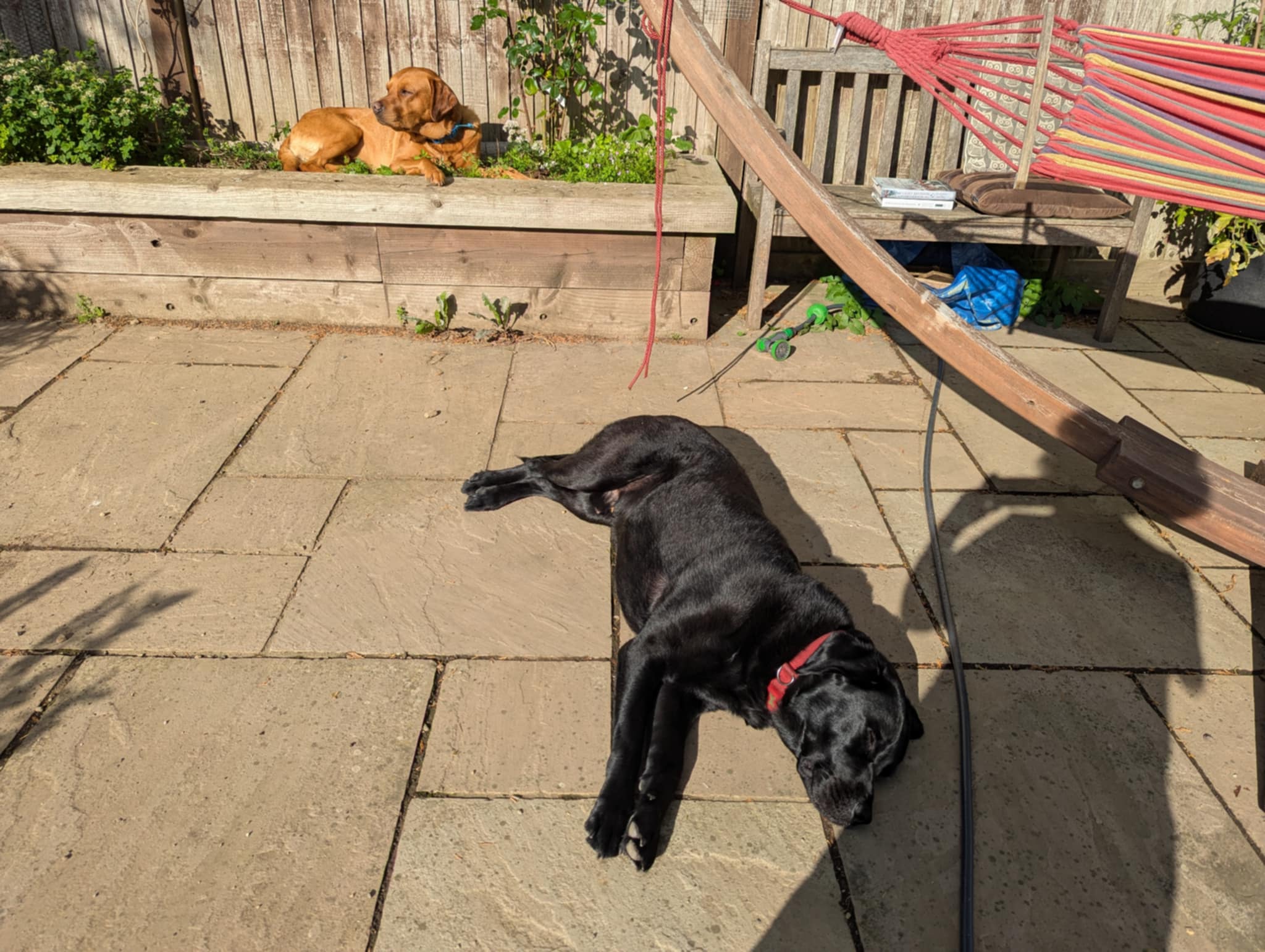
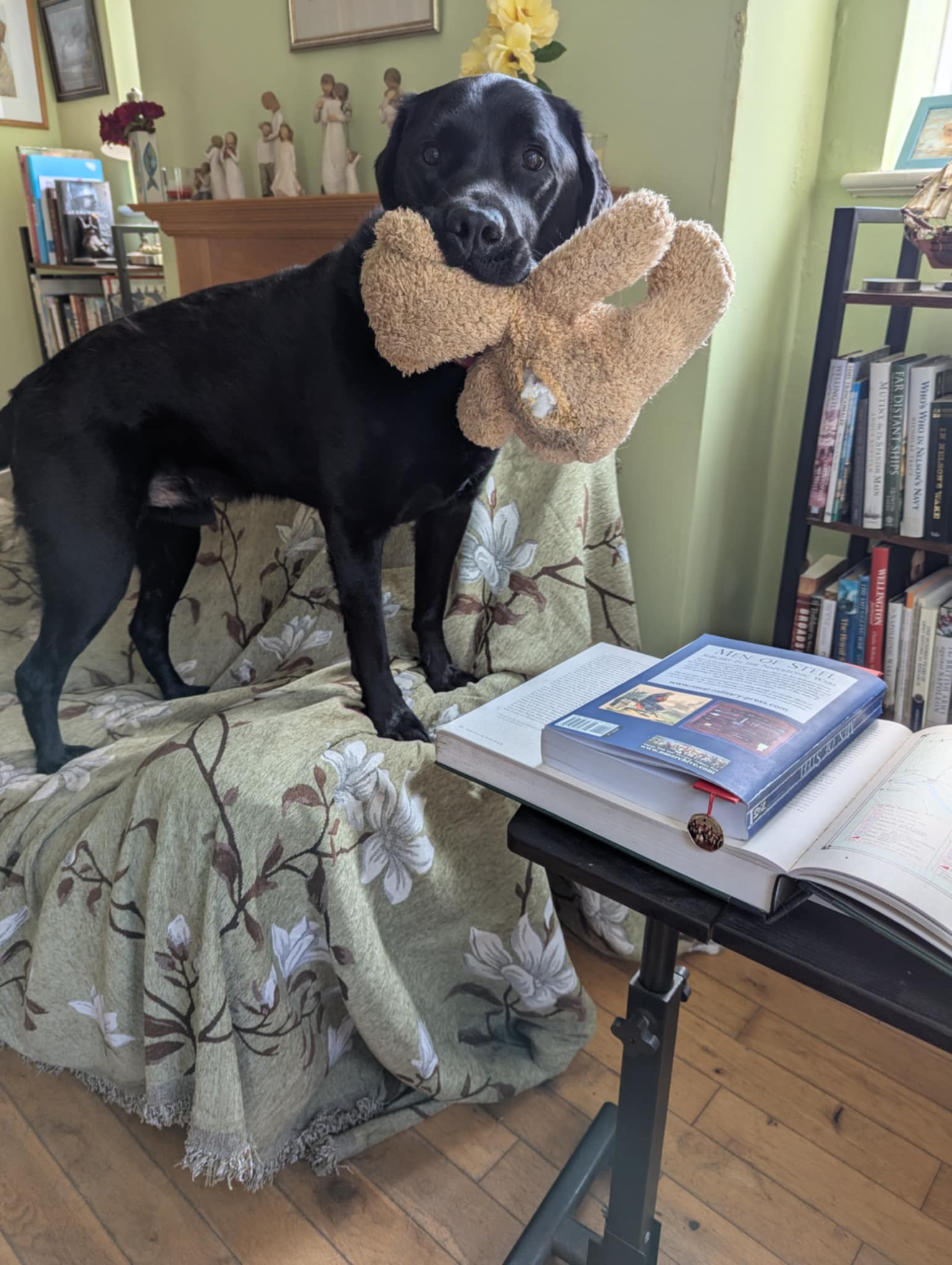

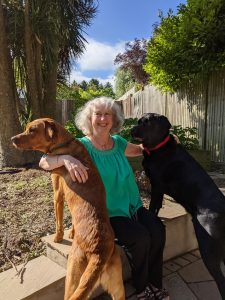 Here comes 2023 at Writing with Labradors and a very Happy New Year to all my friends, family and readers.
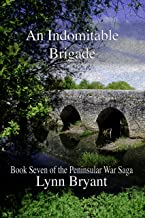 I’d already effectively finished book 7 of the Peninsular War Saga at the end of 2021 and passed it on to my editor. Poor Heather had a somewhat fraught start to 2022 since she knew how desperate I was to get another book out after a year’s gap. She worked very hard despite some health problems of her own and the book was published in April. A
 I went back to
 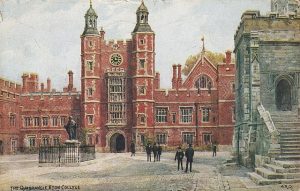 In addition to the two books, I wrote my usual three free short stories this year. Valentine’s Day took us back in time to the winter of 1808-09 and
 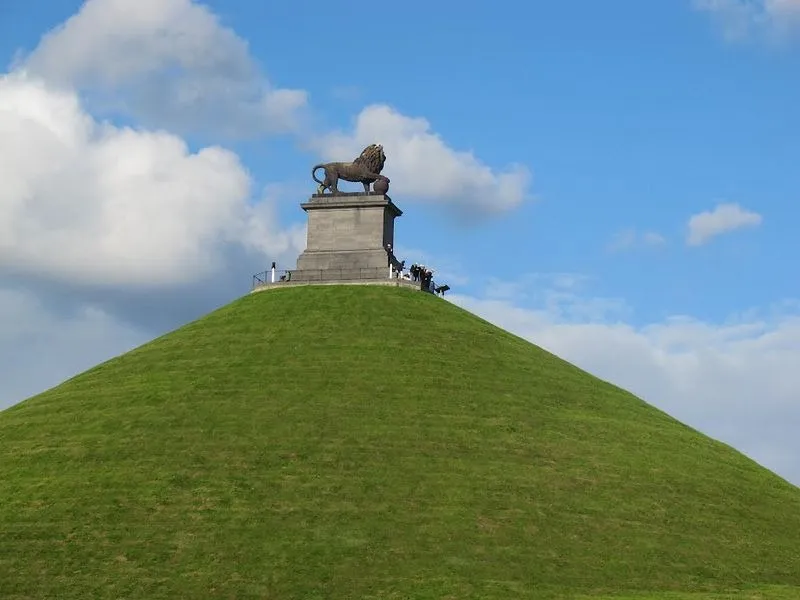 With travel opening up again, I fulfilled a long-held wish and signed up for a Waterloo tour with
 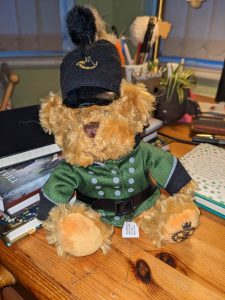 Other trips during the year were more about catching up with friends and family after such a long separation during lockdown. I still managed to slip in some historical visits though, with a trip to the Naval Dockyard in Portsmouth, Maritime Greenwich in London and the Military Museums in Winchester, where I acquired a Rifles bear to add to my desk army.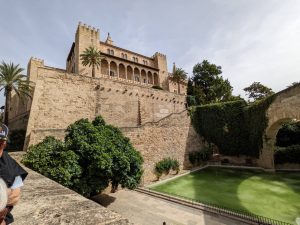
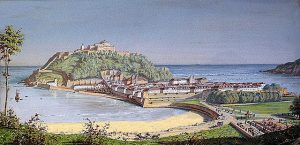 On a personal level, I’ve mostly recovered from the effects of the various lockdowns. I’ve made a start of book 8 of the Peninsular War Saga. It’s called An Unattainable Stronghold and follows the 110th into the Pyrenees and the storming of San Sebastian. After that, I’ll be going back to the Iris to join Hugh Kelly and Alfred Durrell along the coast of northern Spain where they are joining Sir Home Popham on his campaign to annoy the French and the Spanish equally. I’m very much looking forward to the biography of Popham currently being written by my good friend
  The year had a sad ending when we heard that my uncle, William ‘Bill’ Bryant had died. Bill was a huge personality, very much part of my childhood and will be very much missed. He raised a family of history lovers and I laughed aloud during one of the eulogies about his passion for watching war films, despite the fact that he must have seen Zulu and the Battle of Britain a thousand times. The final piece of music played at his funeral was chosen by him, and we both laughed and cried as we left the service to the rousing sound of the Great Escape.

 Welcome to the Jolabokaflod- an annual tradition here at Writing With Labradors. Every year since 2017 I’ve offered some of my books for free on Amazon kindle as a Christmas gift to my readers, old and new.


 I have no idea whether there’s something political about this, whether it’s considered Napoleon was the most important person at Waterloo given that he was an Emperor or whether they just don’t think Wellington or Blucher memorabilia will sell. I do think it should probably be redressed, but if it’s a marketing decision then I guess that’s a good enough reason. All the same, Napoleon as a dog was a bit much for me.
 Across the busy road from the Wellington Museum is the elaborate church which was there at the time of the battle and used, like many churches, as a hospital to receive wounded men. Those of you who have followed me for a while know that I have a thing about old churches and this one was particularly peaceful, with a number of memorials to the men who fought and died during the Waterloo campaign. Memorials at this time tended to be paid for either by the family of the dead man or by subscription through the various battalions and regiments, so not surprisingly more of them relate to the wealthier regiments. Very few of the memorials even mention the NCOs and enlisted men apart from this one in the church, which may well be the first of its kind.
 After lunch we moved on to Napoleon’s Headquarters in the farmhouse of Le Caillou, where Napoleon and his staff spent the night of June 17, 1815. The museum collection is spread over five rooms and tells the story of the Emperor’s actions in the hours before Waterloo. There are a number of artefacts relating to Napoleon, though Gareth queried whether some of the furniture was authentic given that the Prussians reputedly set fire to everything on their way through after Napoleon’s departure. Still, it gives a good sense of how the farm might have looked at the time.
 In the garden outside the farmhouse are one or two memorials. There is also an ossuary, which is a small building intended to serve as the final resting place of human bones. Ossuaries are often used where burial space is scarce but in this case it has become a depository for bones found on the battlefield over the years. I’ve seen photos of this but found the real thing unexpectedly moving.


 Our next visit was to the small but very good museum in Ligny. It covers both Ligny and Quatre Bras and gave a very good sense of what happened on 16th June in these small villages and towns as the French inflicted a bloody defeat on Blucher’s Prussians and fought to a stalemate against Wellington’s Allied army. I was shocked at the extent of the casualties at both battles. Somehow I’d always had the vague impression that these were just skirmishes ahead of the main battle, but they clearly weren’t. All three armies were weakened by what happened on this day and it must have had an effect on what happened at Waterloo.


 NaNoWriMo with Labradors – the first week has gone better than I ever expected. There’s something very motivating about sitting down each day knowing that you’re not going to give up until you’ve at least come close to your word count.
 I love writing about Hugh Kelly and Alfred Durrell but in order to be able to tell the full story of the siege of Tarragona I needed men on the ground. As with the storming of Castro Urdiales in
 Hugh turned his attention to his sextant. It was a bright clear day, making the readings easy. Beside him Manby worked out his latitude in a small notebook and there was silence over the group of observers who were suddenly intent on their work. When the master had finished, he walked aft to where Lieutenant Pryce, the officer of the watch waited. Pryce accepted his report of noon along with the degrees and minutes of the latitude observed.
 NaNoWriMo with Labradors appeared in my brain when I was trying to get back to sleep at 3.45am. I often struggle with sleep due to back problems, but I do try not to actually think when I’m awake. Thinking is fatal as I have the kind of brain which, once it’s fired up, sets off a series of ideas like a row of fireworks going off. This is really useful when creating fictional plots but a complete pain in the early hours of the morning. Let’s just say I’m going to be tired today.
 I realised I’d written a lot more of this book than I thought, which was excellent news. Even better, most of it is very good with the exception of the first two chapters which were utterly superfluous to requirements and probably explain why I struggled with this book first time around. I’ve come up with some new ideas, done some more research, invented a useful new character (with major links to the other series, incidentally) and am ready to go.
 My notebook is ready, my laptop is fired up and the desk army and navy are ready to offer support. This book is happening people…
 Oscar and Alfie are excited about this new initiative at Writing With Labradors, as long as it doesn’t interfere with walks, playtime and mealtimes.
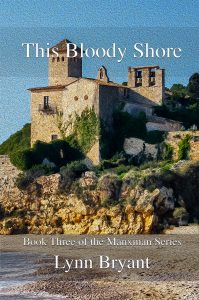
 This Bloody Shore: Book 3 of the Manxman series.
 Here comes 2022 at Writing with Labradors, though it’s arriving a little late. Many apologies, and Happy New Year to you all. In many ways, though, the fact that I’m late with my usual New Year’s greeting is in keeping with the whole of the past year. I had such big plans for 2021 and very few of them came to fruition. Mired down in the misery of restrictions, and beset by family difficulties, it’s been a slow year here at Writing with Labradors and at times, I’ve felt like a complete disaster. Still, things are steadily improving and it’s good to look back because it reminds me there have been some highs as well as lows during this year.
 #High. Once I could travel to the UK, I organised my very own
  #High. I finished book 7 of the
  #High. For the first time I have published a short story in an anthology.
  #High. I was also asked to be part of an anthology of short stories edited by Tom Williams (author of
  #High.
  #High.
  I miss Malcolm. He was only here for a few months, but I got very used to him being around. From the earliest days of my relationship with Richard, almost thirty years ago now, Malcolm and I had a special bond. He shared my enthusiasm for history, and years ago, before I’d ever published, he bought me my first biography of Wellington, the Longford one, from a second-hand book shop. He got on well with my parents, although they didn’t meet that often, and he adored his grandchildren. He loved books and music and was interested in current affairs. He also loved technology, especially cars, and when he was younger, he could fix anything. Before I was even married, he took me for a day out to Silverstone, to watch a Formula One Grand Prix, and we had a fabulous time.
 Richard and I went to London with a van to collect some of their possessions when we still thought they might make a go of living over here. I rather fell in love with a beautiful collection of wooden boats that Malcolm had in his study and mentioned how much I liked them as we were unpacking. To my surprise and delight, he insisted on giving them to me, to go with my wooden model of the Victory in my study. They look beautiful, and I feel as though there’s a little part of him sharing my workspace still. I’m working on a proper obituary for Malcolm. He had an interesting life, and I’d love to share it with people.
 In the meantime, Happy New Year from all of us at Writing with Labradors. I know all of you will have had your highs and lows this year, and many will be a lot worse than mine. Thank you all so much for your support and enthusiasm and your sheer love of the books, the characters and the history. Let’s hope things improve steadily through 2022.